Product Overview
Sandal Fragrance Compound is a prepared aromatic blend designed to impart a sandalwood-inspired fragrance to compatible formulations. Its scent profile may be warm, woody, creamy, soft, or slightly sweet, depending on the fragrance composition.
A fragrance compound may contain natural aromatic ingredients, synthetic fragrance ingredients, or a combination of both. A sandal fragrance compound should not automatically be considered natural sandalwood essential oil.
It can be evaluated for cleaning products and other fragranced formulations when its solubility, stability, intended-use grade, and compatibility meet the product requirements.
Key Features and Benefits
- Sandalwood-inspired aroma: Adds a warm, woody fragrance to compatible products.
- Prepared aromatic blend: May combine natural and synthetic fragrance ingredients.
- Versatile formulation potential: Can be evaluated in selected cleaning and fragranced products.
- Product differentiation: Helps create a recognisable sandal fragrance profile.
- Formulation development: Suitable for fragrance trials and small-batch product testing.
- Compatibility-dependent performance: Results depend on the compound’s specifications and the finished formulation.
Applications
Subject to supplier specifications and compatibility testing, Sandal Fragrance Compound may be evaluated in:
- Floor cleaners
- Colour and perfume phenyl
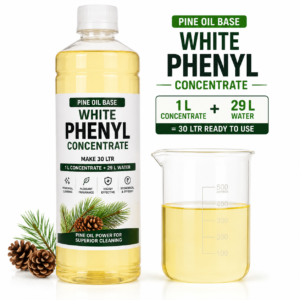
- Pine oil-based phenyl
- Liquid detergents
- Dishwash liquids
- Hand wash formulations
- Bathroom and multipurpose cleaners
- Room fresheners
- Selected soaps and personal-care products, where the supplied grade is suitable
Not every fragrance compound is suitable for every application. Confirm the recommended dosage, solubility, stability, and intended-use requirements before incorporating it into a finished product.
Fragrance Compound vs Essential Oil
What is a Fragrance Compound?
A fragrance compound is a prepared blend of aromatic ingredients designed to create a particular scent, such as sandalwood, rose, jasmine, lavender, or lemon. It may contain natural aromatic ingredients, synthetic fragrance ingredients, or both.
Typical applications: Cleaning products, phenyl, detergents, room fresheners, and other compatible fragranced formulations.
What is an Essential Oil?
An essential oil is a concentrated volatile extract obtained from botanical material through processes such as steam distillation or other suitable extraction methods. Its composition depends on the botanical species, plant part, growing conditions, and extraction process.
Typical applications: Selected fragrance, aromatherapy, and cosmetic formulations, depending on the oil’s identity and intended-use grade.
Key Differences
| Feature | Sandal Fragrance Compound | Sandalwood Essential Oil |
|---|---|---|
| Composition | Prepared blend of aromatic ingredients | Botanical-derived aromatic extract |
| Source | Natural ingredients, synthetic ingredients, or both | Sandalwood botanical material |
| Aroma profile | Designed to provide a particular sandalwood scent | Depends on the species, source, and extraction |
| Consistency | Depends on compound specifications | May vary by source and batch |
| Typical uses | Cleaning products and compatible fragranced formulations | Selected fragrance and cosmetic applications |
| Interchangeability | Not automatically interchangeable with essential oil | Not automatically interchangeable with fragrance compound |
Important: Sandal Fragrance Compound is not necessarily natural sandalwood essential oil. Verify the product identity and intended-use grade before selecting it for a formulation.
Product Specifications
- Product name: Sandal Fragrance Compound
- Product type: Fragrance compound
- Fragrance profile: Sandalwood-inspired, warm, woody, and smooth
- Composition: As specified by the supplier
- Appearance: Depends on the supplied compound
- Solubility: Depends on the fragrance composition and formulation system
- Recommended dosage: Follow the supplier’s technical guidance
- Intended applications: As permitted by the supplied grade and compatibility testing
- Storage conditions: Follow supplier recommendations
- Technical documentation: Request the applicable Safety Data Sheet (SDS) and technical information
Exact composition, colour, flash point, solubility, and recommended dosage should not be assumed without product-specific documentation.
Why Source from MNTENT.com?
MNTENT.com helps customers source selected fragrance compounds and formulation raw materials for:
- Product formulation and development
- Small-batch fragrance trials
- Cleaning-product manufacturing experiments
- Fragrance comparison and evaluation
- Laboratory testing and research
Availability, pack sizes, specifications, and dispatch details depend on the current product listing.
Storage and Handling
- Store in a tightly closed container in a cool, dry, well-ventilated area.
- Protect the fragrance from excessive heat, direct sunlight, and contamination.
- Check the supplier’s SDS for flash point, flammability, and required protective equipment.
- Avoid direct skin and eye contact with concentrated material.
- Do not ingest or apply the concentrated compound directly to the skin.
- Conduct compatibility and stability testing before commercial production.
- For cosmetic or personal-care use, verify that the specific grade meets applicable requirements.
Frequently Asked Questions
1. What is Sandal Fragrance Compound used for?
It may be used to add a sandalwood-inspired aroma to compatible cleaning products and other fragranced formulations.
2. Is Sandal Fragrance Compound the same as sandalwood essential oil?
No. A fragrance compound is a prepared blend of aromatic ingredients, while an essential oil is a botanical-derived volatile extract. They are not automatically interchangeable.
3. Can Sandal Fragrance Compound be used in floor cleaner?
It may be suitable if the compound is compatible with the floor-cleaner formulation. Test solubility, fragrance stability, and the finished product’s appearance before production.
4. Can it be used in phenyl and liquid detergent?
Potentially, depending on the compound’s specifications and compatibility with the formulation. Follow the supplier’s recommended dosage.
5. How much Sandal Fragrance Compound should I add?
The appropriate dosage depends on the compound and the finished product. Follow the supplier’s recommendations and conduct small-scale trials.
6. Is Sandal Fragrance Compound suitable for cosmetics?
Only if the specific grade is documented as suitable for the intended cosmetic application and meets applicable safety and regulatory requirements.
7. Can I purchase Sandal Fragrance Compound in small quantities?
Small quantities may be available through MNTENT.com for testing and formulation evaluation, subject to current stock and pack-size availability.